OpenClaw vs CrewAI: A Detailed Comparison
Compare OpenClaw and CrewAI side by side. Features, pricing, ease of use, and more. Find out which AI agent framework is right for your project.
Overview
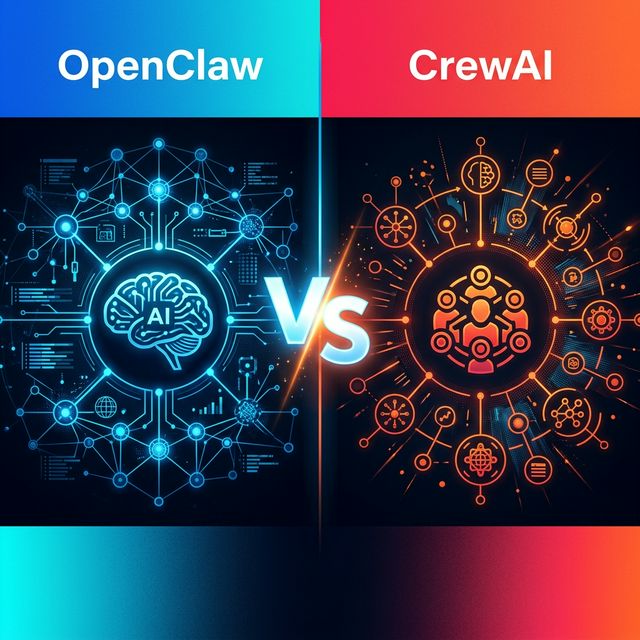
Choosing the right AI agent framework is crucial for your project's success. This article compares OpenClaw and CrewAI across multiple dimensions to help you make an informed decision.
Quick Comparison
| Feature | OpenClaw | CrewAI |
|---|---|---|
| Ease of Use | ⭐⭐⭐⭐⭐ | ⭐⭐⭐⭐ |
| Flexibility | ⭐⭐⭐⭐⭐ | ⭐⭐⭐⭐ |
| Documentation | ⭐⭐⭐⭐⭐ | ⭐⭐⭐⭐ |
| Community | Growing | Established |
| Pricing | Freemium | Open Source |
| Deployment | Multiple options | Self-hosted |
What is OpenClaw?
OpenClaw is a comprehensive AI agent platform designed for developers and businesses who want to build, deploy, and scale AI-powered applications quickly.
Key Strengths
- Intuitive Interface: Built for both developers and non-technical users
- Rich Ecosystem: Extensive library of tools and skills
- Managed Infrastructure: Handles scaling, security, and maintenance
- Enterprise Features: SSO, audit logs, advanced analytics
Best For
- Teams wanting managed infrastructure
- Rapid prototyping and deployment
- Business applications requiring reliability
- Users preferring visual configuration
What is CrewAI?
CrewAI is an open-source framework for orchestrating role-playing, autonomous AI agents. It's built on Python and emphasizes code-first development.
Key Strengths
- Open Source: Full control and customization
- Python Native: Seamless integration with Python ecosystem
- Role-Based Architecture: Powerful multi-agent workflows
- No Vendor Lock-in: Self-hosted, fully customizable
Best For
- Python developers
- Projects requiring full customization
- Teams with DevOps resources
- Research and experimentation
Detailed Feature Comparison
1. Getting Started
OpenClaw
npm install -g openclaw
openclaw new my-project
openclaw dev
Time to first agent: 5 minutes
CrewAI
pip install crewai
Then write Python code:
from crewai import Agent, Task, Crew

researcher = Agent(
    role='Researcher',
    goal='Research topics thoroughly',
    backstory='Expert researcher with years of experience'
)
Time to first agent: 30-60 minutes
Winner: OpenClaw for beginners, CrewAI for Python developers
2. Configuration
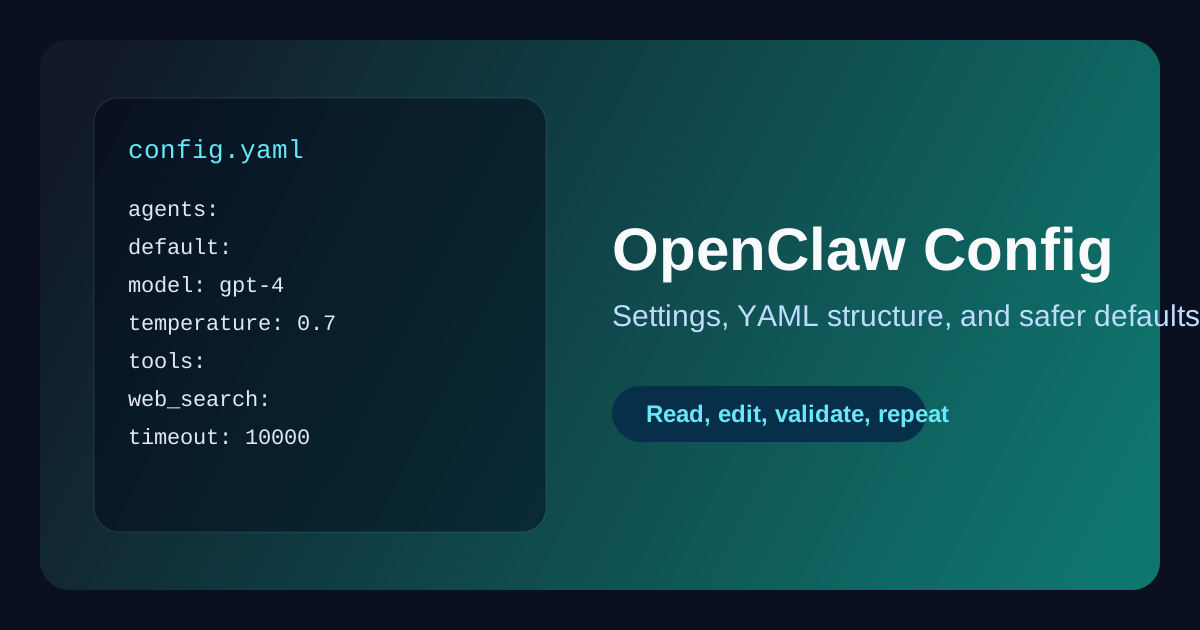
OpenClaw: YAML-Based
# agents/researcher.yaml
name: Research Agent
description: Researches topics and provides summaries

personality:
  thorough: true
  concise: true

capabilities:
  - web_search
  - summarization
Pros:
- Visual and readable
- Easy to version control
- Non-technical team members can edit
CrewAI: Code-Based
# agents.py
researcher = Agent(
    role='Researcher',
    goal='Research topics thoroughly',
    verbose=True,
    allow_delegation=False,
    tools=[search_tool],
    llm=ChatOpenAI(temperature=0.7)
)
Pros:
- Full programmatic control
- Dynamic configuration possible
- Integrates with existing Python code
Winner: Depends on your team's preference
3. Multi-Agent Systems
OpenClaw
Built-in collaboration features:
# config.yaml
collaboration:
  enabled: true
  agents:
    - researcher
    - writer
    - editor
  workflow:
    - researcher -> writer
    - writer -> editor
CrewAI
Explicit task delegation:
crew = Crew(
    agents=[researcher, writer, editor],
    tasks=[research_task, writing_task, editing_task],
    process=Process.sequential
)
Winner: CrewAI for complex workflows, OpenClaw for simpler setups
4. Tool Integration
OpenClaw
Pre-built tool library with one-line integration:
tools:
  - web_search
  - calculator
  - database_query
  - email_sender
CrewAI
Bring your own tools:
from langchain.tools import DuckDuckGoSearchRun

search_tool = DuckDuckGoSearchRun()

agent = Agent(
    tools=[search_tool],
    # ...
)
Winner: OpenClaw for convenience, CrewAI for flexibility
5. Deployment
OpenClaw
Multiple deployment options:
- Cloud: One-click deploy to OpenClaw Cloud
- Self-hosted: Docker containers
- Edge: Cloudflare Workers, Vercel Edge
openclaw deploy --platform cloud
CrewAI
Self-hosted only:
- Docker containers
- Python application servers
- Cloud VMs
docker build -t my-crew .
docker run -p 8000:8000 my-crew
Winner: OpenClaw for ease of deployment
6. Monitoring & Observability
OpenClaw
Built-in dashboard:
- Conversation logs
- Performance metrics
- Error tracking
- Cost analytics
CrewAI
External tools required:
- LangSmith
- Custom logging
- OpenTelemetry
Winner: OpenClaw
Use Case Scenarios
Scenario 1: Quick Prototype
Team: Startup, 2 developers Goal: Build a customer support agent in 1 week
Recommendation: OpenClaw
- Faster setup
- Pre-built tools
- Less code to write
Scenario 2: Enterprise Integration
Team: Large company, dedicated ML team Goal: Integrate with existing Python ML pipeline
Recommendation: CrewAI
- Full control
- Python ecosystem
- Customizable to requirements
Scenario 3: Research Project
Team: University researchers Goal: Experiment with multi-agent architectures
Recommendation: CrewAI
- Open source
- Easy to modify
- Academic-friendly license
Scenario 4: Business Automation
Team: Small business, limited technical staff Goal: Automate repetitive tasks
Recommendation: OpenClaw
- Visual configuration
- Managed infrastructure
- Support available
Pricing Comparison
OpenClaw
- Free Tier: 3 agents, 1,000 messages/month
- Pro: $49/month, unlimited agents, 10,000 messages
- Enterprise: Custom pricing, dedicated support
CrewAI
- Open Source: Free (self-hosted)
- Infrastructure costs: Varies by deployment
- Development time: Higher initial investment
Total Cost of Ownership:
- OpenClaw: Predictable monthly cost
- CrewAI: Variable based on infrastructure + development time
Community & Support
OpenClaw
- Discord: 5,000+ members
- Documentation: Comprehensive guides + API reference
- Support: Email + community forums
- Enterprise: Dedicated support for paid plans
CrewAI
- GitHub: 20,000+ stars
- Discord: 10,000+ members
- Documentation: Good coverage
- Support: Community-driven
Winner: CrewAI for community size, OpenClaw for official support
Migration Between Platforms
OpenClaw → CrewAI
- Export agent configurations
- Rewrite in Python
- Re-implement tools
- Set up infrastructure
Effort: High
CrewAI → OpenClaw
- Create OpenClaw project
- Port agent definitions to YAML
- Configure tools via UI
- Deploy
Effort: Medium
Which Should You Choose?
Choose OpenClaw if:
- ✅ You want to deploy quickly
- ✅ You prefer visual/YAML configuration
- ✅ You need managed infrastructure
- ✅ You want pre-built tools
- ✅ You have limited DevOps resources
- ✅ You need enterprise features
Choose CrewAI if:
- ✅ You're a Python developer
- ✅ You need full customization
- ✅ You want open source
- ✅ You have specific infrastructure requirements
- ✅ You're doing research or experimentation
- ✅ You want no vendor lock-in
Hybrid Approach
Many teams use both:
- OpenClaw for production applications
- CrewAI for research and prototyping
FAQ
Q: Can I use OpenClaw and CrewAI together?
A: Yes! You can build agents in CrewAI and integrate them with OpenClaw via APIs.
Q: Which has better performance?
A: Both are performant. OpenClaw may have lower latency due to optimized infrastructure.
Q: Can I switch between them later?
A: Yes, but it requires rewriting agent configurations.
Q: Which is better for beginners?
A: OpenClaw has a gentler learning curve for non-developers.
Conclusion
Both OpenClaw and CrewAI are excellent choices for building AI agents. Your decision should be based on:
- Team skills: Python developers may prefer CrewAI
- Timeline: OpenClaw for faster deployment
- Control needs: CrewAI for maximum flexibility
- Infrastructure: OpenClaw for managed hosting
There's no universally "better" option—only the one that fits your specific needs.
Still unsure? Try both! OpenClaw's free tier and CrewAI's open-source nature make it easy to experiment.
Additional Resources
OpenClaw Security & Deployment Brief
Get the weekly OpenClaw Security & Deployment Brief — malicious skill alerts, CVE breakdowns, cost optimization tips.